The Anatomy of a Siege
I didn’t learn this in a laboratory.
I learned it at 3:17 in the morning, in a silence so total it had physical weight. I was lying in a bed I chose, in a home I made, in a life that, by almost any external measure, was secure.
The room was dark. No alarms. No urgent emails. No immediate threats. Just the darkness, and me. My heart was pounding as though something enormous was coming through the wall. My jaw was locked so tightly it ached. My breath stayed high and shallow, short, guarded, unfinished, almost choking. I lay completely still, waiting for the surge to pass.
It didn’t.
Nothing was chasing me. Nothing needed to.
I was armed. I was locked. And I was loaded, not because of anything hunting me, but because of the life I was trying to live.
I did not yet understand that my nervous system barely distinguishes a predator from a calendar that never empties. What it weighs, above almost everything, is threat load. Mine had long since crossed the threshold, without an alarm, without a diagnosis, without a name.
Most people call this stress. That word is too small.
Stress implies you can manage it with habits, mindset, or a weekend off. What is happening here is different. It is a state shift, a control takeover. A siege that doesn’t feel like a siege anymore because it has become your new normal.
When my wife of twenty-five years, Anita, passed away, she took my North Star with her. Grief, I expected. What I did not expect was what followed, not sadness deepening, but biology mobilising.
Her absence did not register in my system as loss. It registered as threat. Unresolvable. Environmental. Permanent.
The internal alarms switched on, and then something broke: the off switch stopped working.
I tried everything to shut it down. Cold exposure. Extended fasting. Precision HRV tracking. Breath protocols. Night-dosed melatonin. Meditation. Prayer. Chanting. Silence. I pursued data and devotion with equal intensity. I consulted neurologists, cardiologists, endocrinologists, and sleep specialists.
Each addressed a fragment. None touched the mechanism.
More medication. Less relief.
They were looking for a malfunction. They found nothing, because nothing was malfunctioning.
My body was not broken. It was protecting me. Relentlessly and without a switch to turn it off.
Then, in my work at MI.BO., an uncomfortable discovery revealed itself. What I found in my own body, I then found in most of the three hundred thousand face scan readings of others. The same physiological framework I was trapped inside was appearing, again and again.
Not people who had experienced loss. Not people in clinical crisis. People running companies, raising children, managing teams, optimising their biology with expensive protocols and genuine commitment. People who looked, from the outside, like they were fine. People whose scans told a different story: the same suppressed HRV trend, the same vagal withdrawal, the same brainstem verdict running quietly beneath the surface of a functional life.
The signal was faint. The system underneath it was not.
It surfaces as jaw tension, restricted breath, and forward posture; it manifests as fragmented sleep and plateaued weight loss. Even in those using the most advanced metabolic interventions available, the body continued to defend itself.
Armed bodies, running the same siege protocol, triggered not by grief but by relentless schedules, chronic screen exposure, and the low-grade, inescapable frequency of a life lived permanently at threshold.
I did not invent this pattern. I found it, in the anonymous biometric data of faces from six continents.
That’s when I named it NeuraGrip.
NeuraGrip is the body’s survival grip: a state in which your nervous system stays in defence mode, bracing against a threat it keeps predicting but never resolves. It hijacks your energy, metabolism, sleep, and repair. It can change how GLP-1 signals land. Over time, it reshapes the body from the inside out, surfacing as symptoms you may mistake for separate problems.
The danger that installed it has passed. What keeps it running is the prediction that it hasn’t. Because the body-being braces against that prediction, it produces the very signals, the tension, the wired exhaustion, the unrest beneath the surface that seem to confirm the threat is still present. The nervous system reads its own bracing as evidence. The loop closes on itself.
When the nervous system stays armed, sleep loses depth. Recovery becomes incomplete. Metabolism shifts toward conservation. Visceral fat becomes protected storage. Inflammation rises.
What the wellness industry has been treating as separate problems, the exhaustion, the weight that won’t move, the brain fog, the anxiety, may, in many bodies, be connected by one upstream state.
Even in people using GLP-1 therapies, where hunger had been pharmacologically quieted, the same defended pattern appeared: poor sleep, suppressed recovery, stalled progress, and muscle at risk.
The mechanism did not care about the cause. Grief had evoked it in me. It comes pre-installed in everybody and it does not distinguish between reasons. It reads for one thing above all: whether the evidence of safety has arrived. In the people we scanned, more often than not, it had not.
Held long enough, it may quietly erode healthspan, not dramatically in a day, but across years. If you have ever lain awake in the early hours, wired and exhausted, waiting for a surge that has no name, you already know the feeling from the inside.
It may feel like anxiety, stress, ageing, or weakness. That is your body holding you hostage to keep you alive. What if the threat your body is perceiving isn’t actually there?
Now you have a name for it.
And no medication, not even the most effective weight-loss drug ever invented, can resolve, on its own, the defensive autonomic configuration your body may still be holding.
This book is not a memoir. Loss was simply the catalyst that made the invisible visible. What follows is what I learned when I stopped trying to escape the siege and started learning its language, because the moment you can name the mechanism, you can interrupt it.
You don’t need to fear it. You need a release signal. And once you learn how to deliver it, you begin to live Bio-Sovereign.
Are You NeuraGripped?
What if the threat your body is perceiving isn’t actually there?
The architecture is universal. The survival system is built into every human being.
The issue is not whether it activates. It is whether it stands down when the threat has passed.
Take the Hostage Audit to find out.
This is not a clinical diagnosis. It is a pattern-recognition exercise. The nine signs are not nine separate problems. They are different expressions of one possible mechanism: a nervous system that has not received enough evidence to stand down.
Read each one slowly. Focus on the feeling, not how the words sound. Tick each sign you recognise in yourself from the last fortnight. Hold on to that number. What comes next may reveal something remarkable about your own body.
The Hostage Audit captures what you feel. Next, you will be able to measure what your body appears to be carrying.
Across our dataset, the gap between what people felt and reported and what their physiology later measured averaged roughly twenty-four points, in the same direction. The body showed more grip than the person believed they were carrying.
That gap matters.
The NeuraGrip Polygraph will make that gap visible to you. We explain the finding, the measurement and why it matters in Appendix A.3.
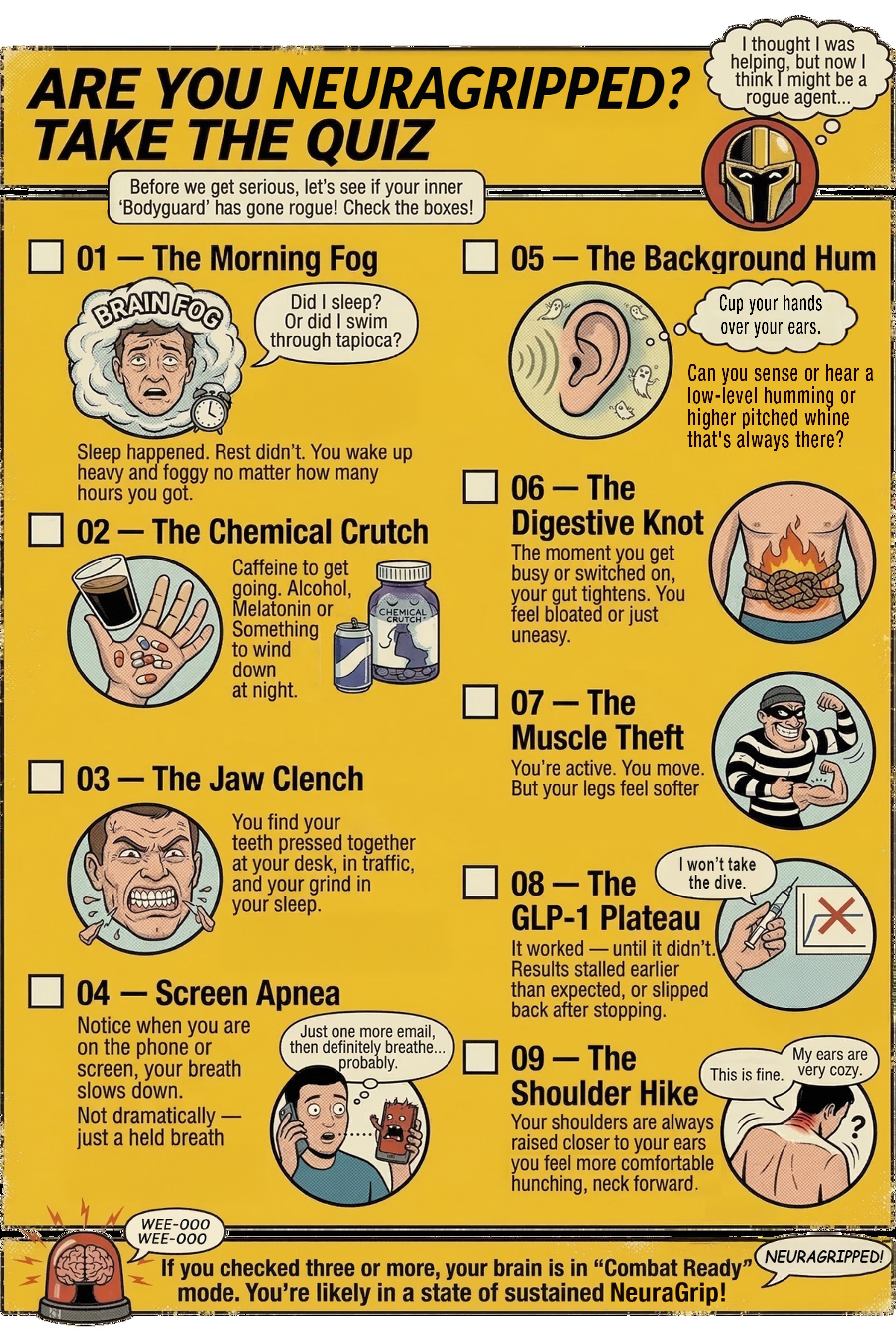
DO YOU RECOGNISE THE GRIP?
Take the live 9-point Hostage Audit. Your reading place is saved automatically.
Two Lenses, One Mechanism
The book has two voices. Both are speaking to you.
Your nervous system doesn’t read books; it reads signals.
NeuraGrip is explained through two lenses, supported by highlights and tested through practical tools.
The Comic Lens uses two recurring characters to make the autonomic nervous system easier to understand. The Bodyguard represents sympathetic defence: alert, protective and sometimes slow to stand down. The Captain represents parasympathetic recovery: the state that supports digestion, repair and rebuilding.
The Clinical Lens provides short evidence boxes throughout the book, with the supporting research referenced in the bibliography.
The Did You Know? boxes highlight surprising facts and concise explanations about the nervous system, posture, breathing, metabolism, sleep and recovery. They connect the science of NeuraGrip to what may already be happening in your own body.
The Lab in Your Pocket lets you explore the pattern through five touchpoints: the Hostage Audit, the Micro-Reset, the NeuraGrip Polygraph, the Wall Test and the NeuraGrip Platform.
Together, they speak to your brain in its native tongue.
The Longevity Blind Spot
NeuraGrip is not anti-optimisation. It is pre-optimisation.
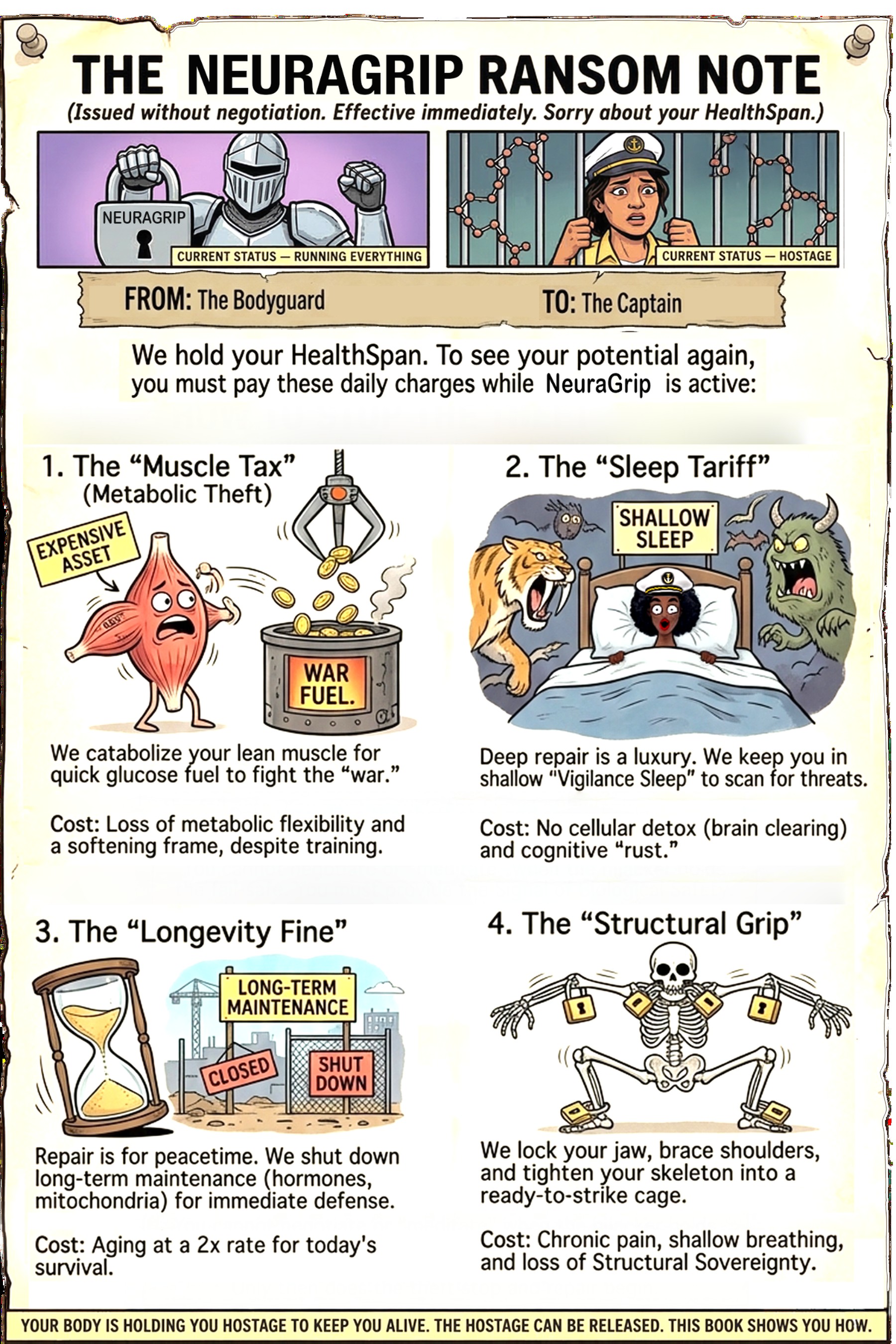
The modern living human is trapped in a loop of diminishing returns. Whether you are chasing the Bryan Johnson Blueprint, or shocking your body with 5 a.m. cold plunges, or simply trying to survive a back-to-back corporate schedule on caffeine and grit, your nervous system is reading the same metric: Demand.
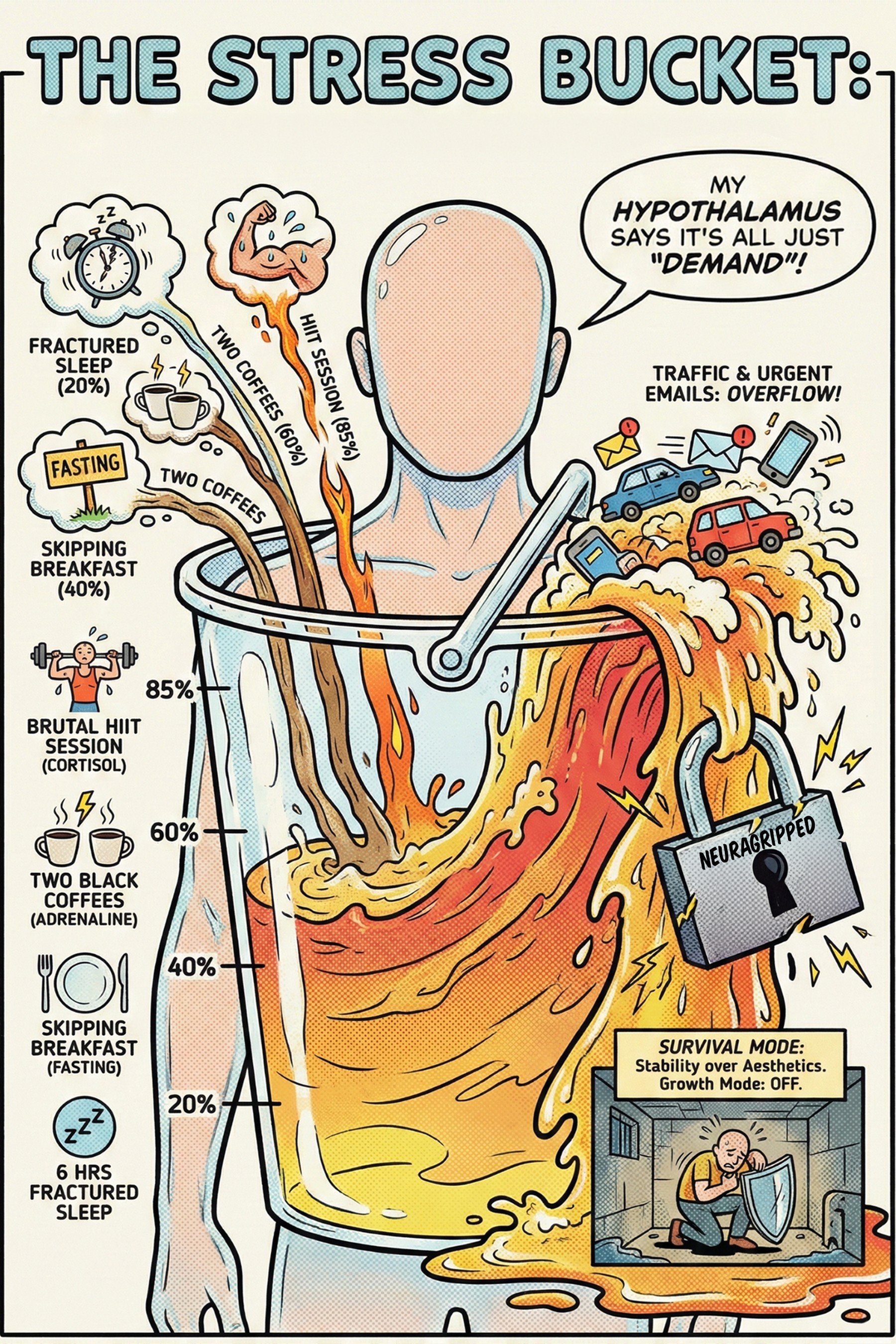
Your hypothalamus has no folder for ‘voluntary biohacking’.
It does not know that the 48-hour fast was a choice, that the HIIT session was discipline, or that the light sleep is from excessive travel. It only sees a bucket that is overflowing.
Maybe you turned to a GLP-1 medication, the most advanced metabolic intervention on earth, expecting it to override biology itself. Appetite controlled. Discipline outsourced. Hunger silenced. And still the progress slowed. Then stopped.
Maybe you came at it from the other direction. You cleaned up the diet, tracked every gram of protein, mastered the fast, trained hard, optimised your sleep like a laboratory, and watched the results plateau, fragment, and settle far below where the effort should have carried you.
Or maybe you have never tracked a biometric in your life. You’re an exhausted professional, a caregiver, someone balancing a schedule that never empties.
It doesn’t matter which door you came through or how many thousands of dollars and hours you invested. The needle hasn’t just stopped; it has fused to the dial. The weight won’t drop. The belly won’t flatten. The brain fog lingers like a permanent morning mist. The sleep doesn’t restore. The system doesn’t recover.
Here is the friction: your biology is currently at war with your discipline. This is not a failure of willpower.
It is a longevity blind spot.
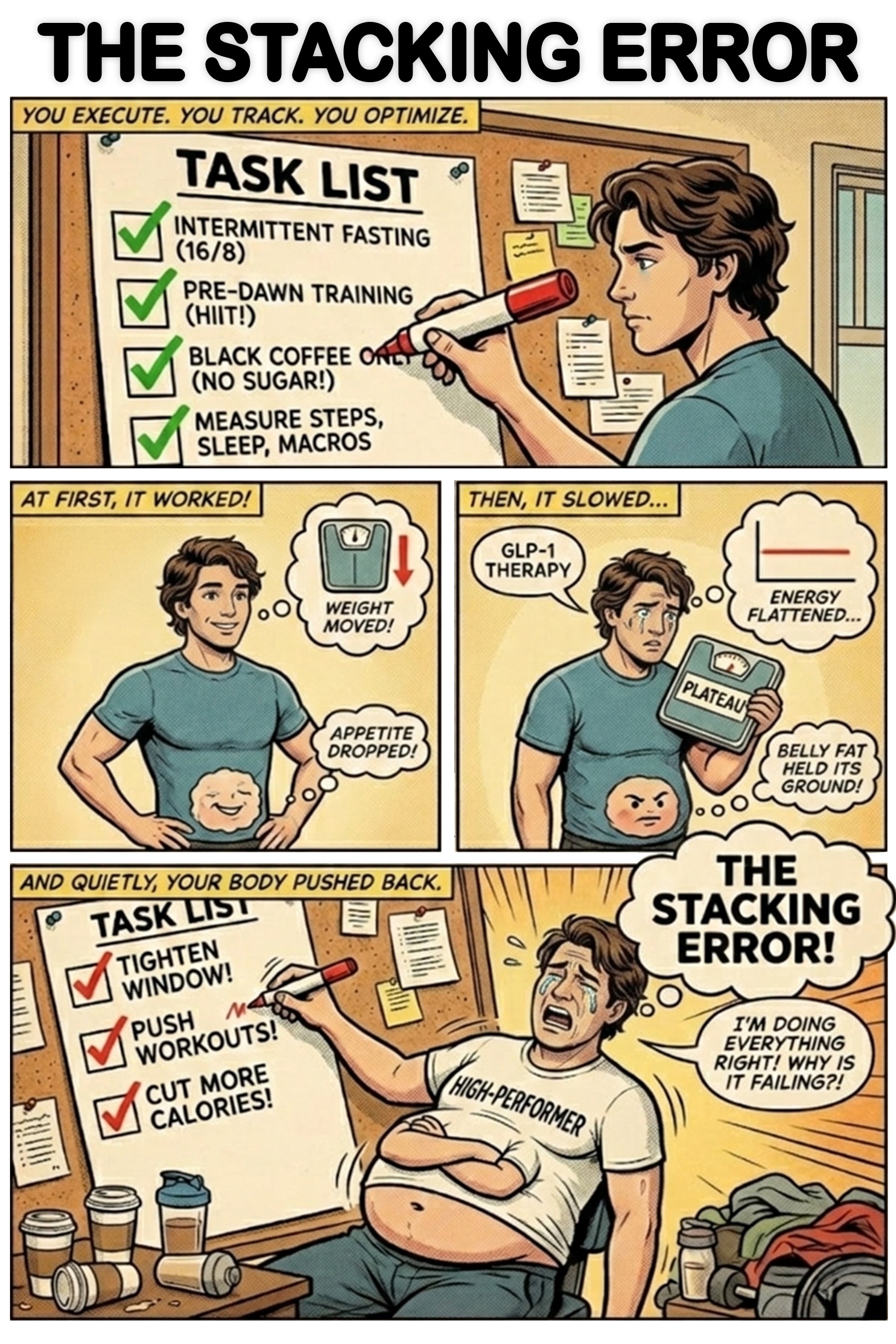
An executive in his late thirties had built his life into a fitness regimen. Cold plunge at dawn, fasted training, every supplement timed, sleep scored each night and reviewed each morning, the readiness number on his wrist consulted before he decided how to feel. For a while it worked, or seemed to. Then the numbers began to slide, and the harder he optimised, the worse they got.
What he could not see was that the regime had become the threat. Every metric was one more checkpoint his body had to pass, every protocol one more demand arriving before dawn, every red number a small verdict of failure. He had turned his own nervous system into something to be audited, and it had done what anyone does under constant inspection. It tightened.
“I was doing everything to recover, and I’d never felt less recovered in my life. I think the chasing was the problem. I never let my body off the hook long enough to actually relax.”
Cold exposure, breathwork and posture work can create a powerful feeling of control, and they produce real physiological effects. But in isolation they rarely resolve the state underneath.
A gripped system can feel better while staying locked. The appetite drops, the weight moves, and then, without warning, it slows, stabilises, stops. Not because the intervention failed, but because the intervention may not be reaching the part of the system that is keeping the body defended.
Your hypothalamus is an ancient regulator that evolved for a world very different from today. It was built to manage famine, predators and winter, not inboxes, commutes, deadlines and a calendar that never empties. Under sustained stress, one priority can begin to override all others: perceived threat. And when threat load crosses a threshold, the body stops rewarding your investment and starts protecting itself from it. This paradox forms the foundational hypothesis of NeuraGrip.
The Missing Diagnosis
The longevity industry looks at your plateau and calls it stress. It prescribes another app, another supplement, a relaxing vacation. The pharmaceutical conversation looks at your medication plateau and calls you a non-responder, a statistical variation to be managed with a dose adjustment.
Both diagnoses are misunderstood in the same way.
They are treating the output of a state without identifying the state. The weight that will not move, the sleep that will not restore, the medication that will not hold, these are not separate problems requiring separate solutions.
While you were busy stacking every healthy habit you could find, you fell victim to The Longevity Blind Spot, the belief that more intensity equals more vitality.
Weight loss is not the same as fat loss.
Override vs. Unlock
GLP-1 therapy exposed the flaw in modern weight loss: appetite is not the whole system. You can quiet hunger and still leave the body defended.
That defended state is NeuraGrip.
Consider what can happen during GLP-1 therapy. The drug works. Hunger quiets. Food noise drops. The scale begins to move. A weekly injection or daily tablet can send an amplified satiety signal. It can help you eat less. It can open a door that may have been locked for years. It is performing a chemical override. Starting is easy. Stopping is where biology speaks.
The drug is proven to be effective. But it does not arrive in a vacuum. It arrives in a body. And if that body is armed, braced, under-slept, under-muscled, under-fed, and still reading scarcity, the signal has to fight through a receiver that has not stood down.
This is not a book about what’s wrong with GLP-1 medications. The drug, working exactly as designed, buys you something specific and real: a quieter appetite, less food noise, a little metabolic room. That matters. For some people, it is life-changing. This is a book about the body they land in and why appetite can be quiet while the system underneath is still holding the grip.
Synchronise Before You Optimise
The drug can lower your appetite. It cannot stand down your guard. If your sleep is fragmented, your recovery is poor, and your nervous system remains armed, your body will hit the plateau long before you hit your goal.
The missing variable is not a better drug or a more expensive supplement. It is synchronisation.
Same drug, same dose. Different body, different result.
Synchronisation is a biological state: the condition in which the body’s systems run in time with each other and with the day’s cycle. I hold this strongly, but I’ll show you where the evidence for it stops. A synchronised body receives its inputs as it was built to, sleep consolidates, hormones cycle, appetite signals land.
An unsynchronised one runs every input through a substrate working at cross-purposes with itself, and the best intervention in the world arrives at a receiver that isn’t ready for it.
NeuraGrip does not explain every GLP-1 plateau. But autonomic state may be one overlooked variable in how satiety, appetite, recovery, sleep, protein intake, and lean-mass preservation interact during GLP-1 therapy.
GLP-1 drugs changed the weight-loss conversation. NeuraGrip explains the body they are landing in.
Your Stress Bucket: The Silent Overflow
To rewrite the code of your longevity, you must understand how your body defines stress. Your hypothalamus doesn’t care if the trigger is a 24-hour fast, a double espresso, or a looming deadline. To your biology, it is all one thing: Demand.
Imagine your nervous system as a bucket. Every demand, from a work deadline to a heavy squat to a missed meal, fills it.
The bucket fills quietly. There is no alarm. No flashing warning. When the total Threat Load crosses the threshold, your system stops rewarding your effort. It initiates a survival protocol.
Your body isn’t sabotaging you. Your bucket is simply full.
The Missing Variable
You have probably felt a version of this in your own life. The discipline that did not produce the return it should have. The sleep protocol that worked for three weeks. The medication that helped and then didn’t. The training block where everything looked right on paper and the results refused to follow.
The bucket is the trigger. The Four Locks you learn about later in the book are what it triggers.
CHECK THE SCIENCE WITHOUT LOSING YOUR PLACE.
Open the evidence summary here first. From there, the full Science Library is one tap away without losing your place.
Flip the Switch
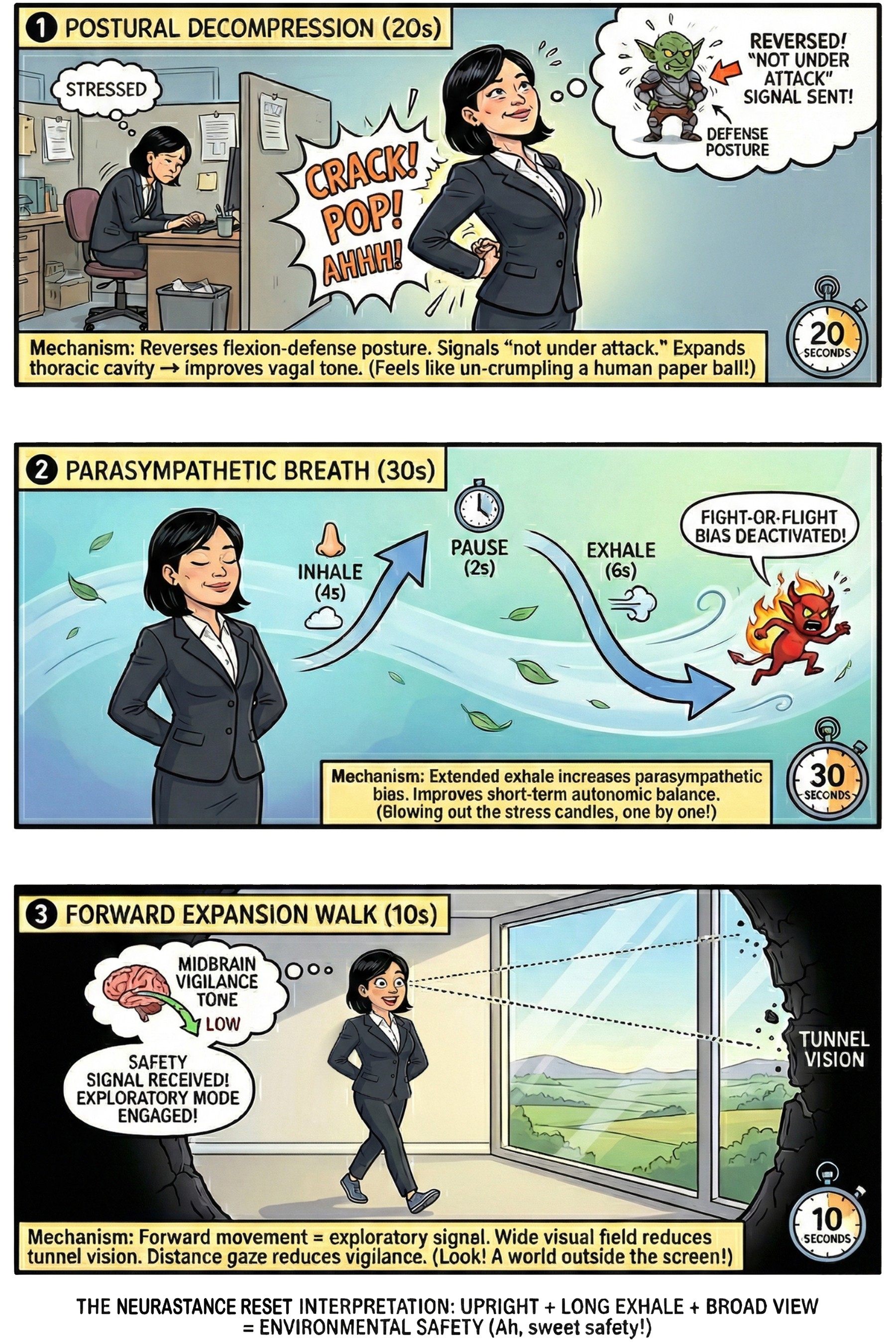
Put the theory to the test. Sixty seconds. Three signals. One verdict shift.
Understand this: this is not relaxation. It is a coordinated autonomic reset. You are about to stand down the Bodyguard’s control panel by reversing three specific threat markers simultaneously: collapsed structure, compressed breath, and narrowed vision.
When these three shift together, the brainstem receives a coordinated signal that may prompt recalibration. We call it The Micro-Reset Demo.
Sixty seconds. Three steps. One compound signal to the brainstem, delivered through your skeleton.
INITIATE THE CAPTAIN’S POSE
Stand tall. Interlace your hands behind your lower back. Draw your shoulders down and back while lifting your chest. Keep your chin level and your neck long.
LOCK THE BREATH
Inhale through the nose for four counts. Brief pause. Exhale slowly through pursed lips for six counts. Repeat.
SHIFT TO HORIZON
Maintain the interlaced hands. Stand or walk. Look into a window or an open space. Lift your gaze toward the distance and let your eyes widen naturally. Do not look at a screen.
The Post-Sequence Audit
You may experience an immediate shift in your jaw tension, the weight of your shoulders, and the speed of your thoughts. This Reset aligns with the principles of allostatic load reduction and vagal tone modulation.
If you feel even a slight loosening of the grip, you have just achieved Proof of Concept. You have evidence that your system can respond and it is adaptive.
The point is not the magnitude. The point is that the system responded. Not a treatment, but a signal the body already knows how to answer.
This is the introductory form of the Instant Reset, the micro-version of the same signal sequence the book builds to in full. What you are feeling now is the proof that the system responds. In Part V we will deliver the complete protocol.
The Bodyguard and the Captain
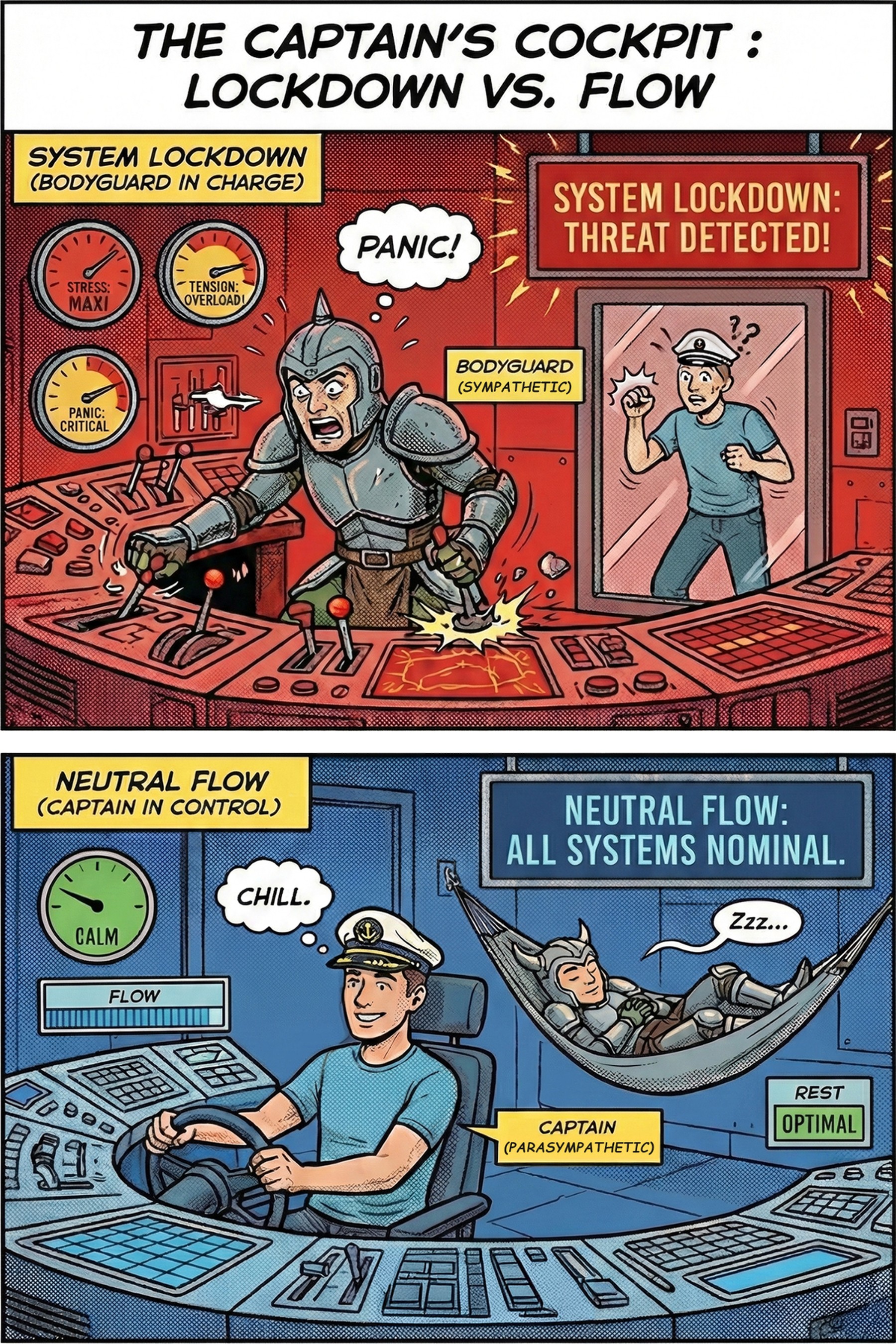
Two states. One body. The whole framework in two characters.
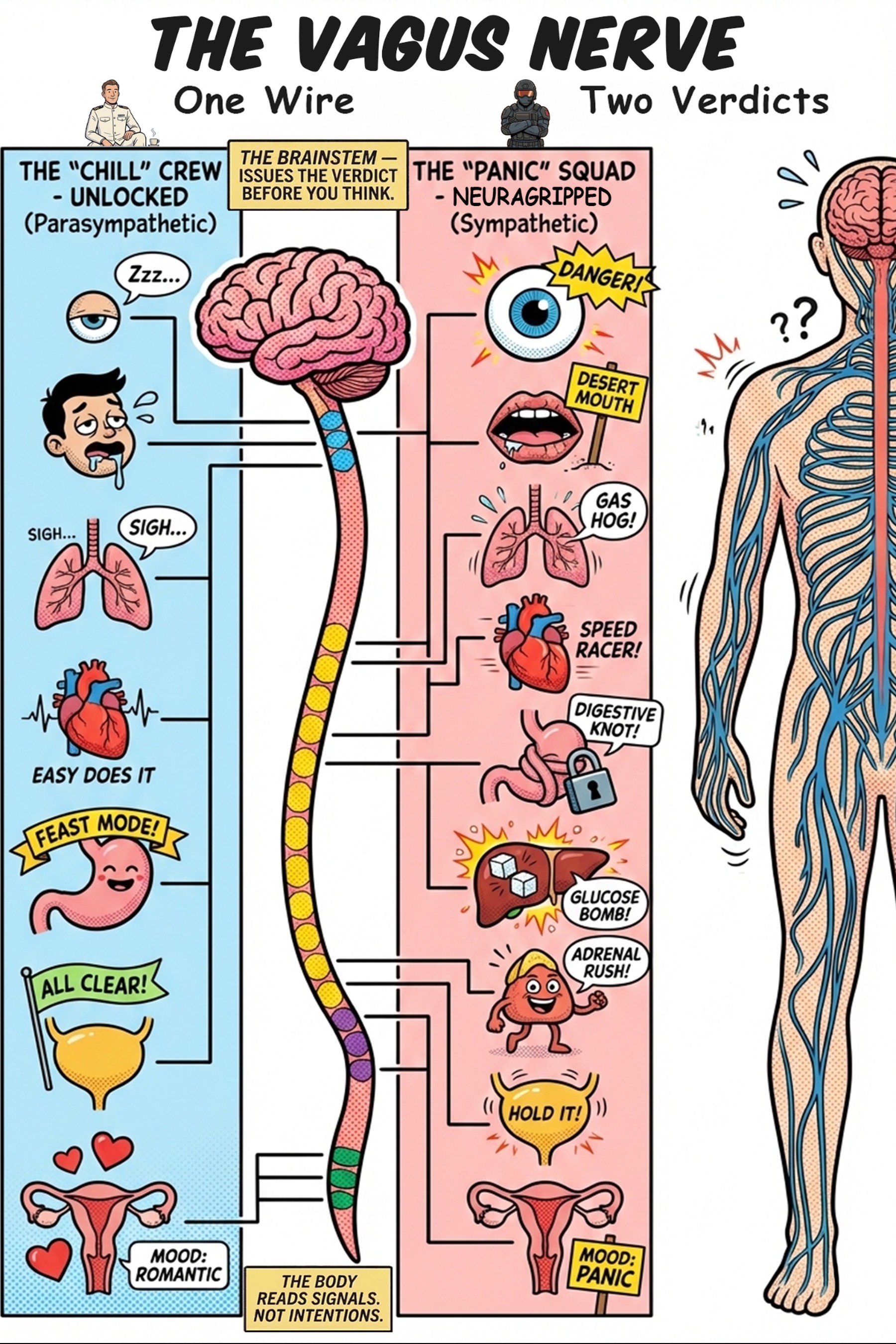
So far, our biological hierarchy relies on two operators: The Bodyguard, which mobilises, and The Captain, which restores. But a command is only as good as the infrastructure it travels on. Between the two runs a third presence, a biological wire we will return to so often it requires naming now.
It is the vagus nerve.
In Latin, vagus means wandering, and the nerve earns its title. It is the longest cranial nerve in the body, leaving the brainstem and wandering down through the throat, the chest, the heart, the lungs, and the gut. It is one of the main physical lines the stand-down order travels on.
When the Bodyguard finally lowers its guard, the vagus helps that decision reach your anatomy, the message that says, in effect, the emergency is over, you may rest.
Physiologists call this the vagal brake. When the brake engages, the heart slows, the breath deepens, and metabolic repair can resume. When it stays weak or unresponsive, the body may struggle to receive the all-clear, no matter how calm the Captain believes things to be.
There is a way to find out whether the Bodyguard has stood down or is still holding the line, to put a number on your own NeuraGrip state. It is called the NeuraGrip Polygraph, and it is included free with this book.
The Bodyguard: The Sympathetic Defence State
You are likely familiar with the phrase fight-or-flight response. The fuller picture is four: Fight, Flight, Freeze, Fawn.
I call your sympathetic nervous system the Bodyguard.
Not because it is aggressive. Because it is loyal. Relentlessly, brilliantly, completely loyal, to you, to your survival, to the single directive it was given before you were old enough to have an opinion about it: to keep this body-being alive.
The Bodyguard does not negotiate. It does not take days off. It does not distinguish between a genuine threat and a symbolic one. It doesn’t distinguish between a predator and a performance review, between grief and an overflowing inbox. It reads one metric, Threat Load. When Threat Load crosses the threshold, the Bodyguard takes the wheel.
The Captain: The Parasympathetic Growth State
And then there is the Captain.
Your parasympathetic nervous system. The state the body runs when the Bodyguard finally, finally, stands down. The Captain is where muscle is built, DNA is repaired, sleep deepens, and the GLP-1 signal lands as it was designed to.
The Captain is where recovery lives, where creativity lives, where the kind of thinking that doesn’t feel like effort lives.
The Captain only steers when the Bodyguard steps aside. And the Bodyguard only steps aside when it receives one specific kind of signal, evidence.
Not reassurance. Not understanding. Not a commitment to relax.
Biological proof that the war is over.
SEE THE EVIDENCE BEHIND THE MECHANISM.
Open the evidence summary here first, then go to the full Science Library if you want the source record. Your place in the FREE PREVIEW stays exactly where you left it.
This Book Reads You
Validate the signal, measure your NeuraGrip.
That NeuraStance Micro-Reset shift you just felt, the loosening of the jaw, the drop in urgency, the expansion of your breath, is the first physical evidence that your system is adaptive. You just interrupted a defence pattern in under sixty seconds. Not with mindset. Not with intensity. With signal.
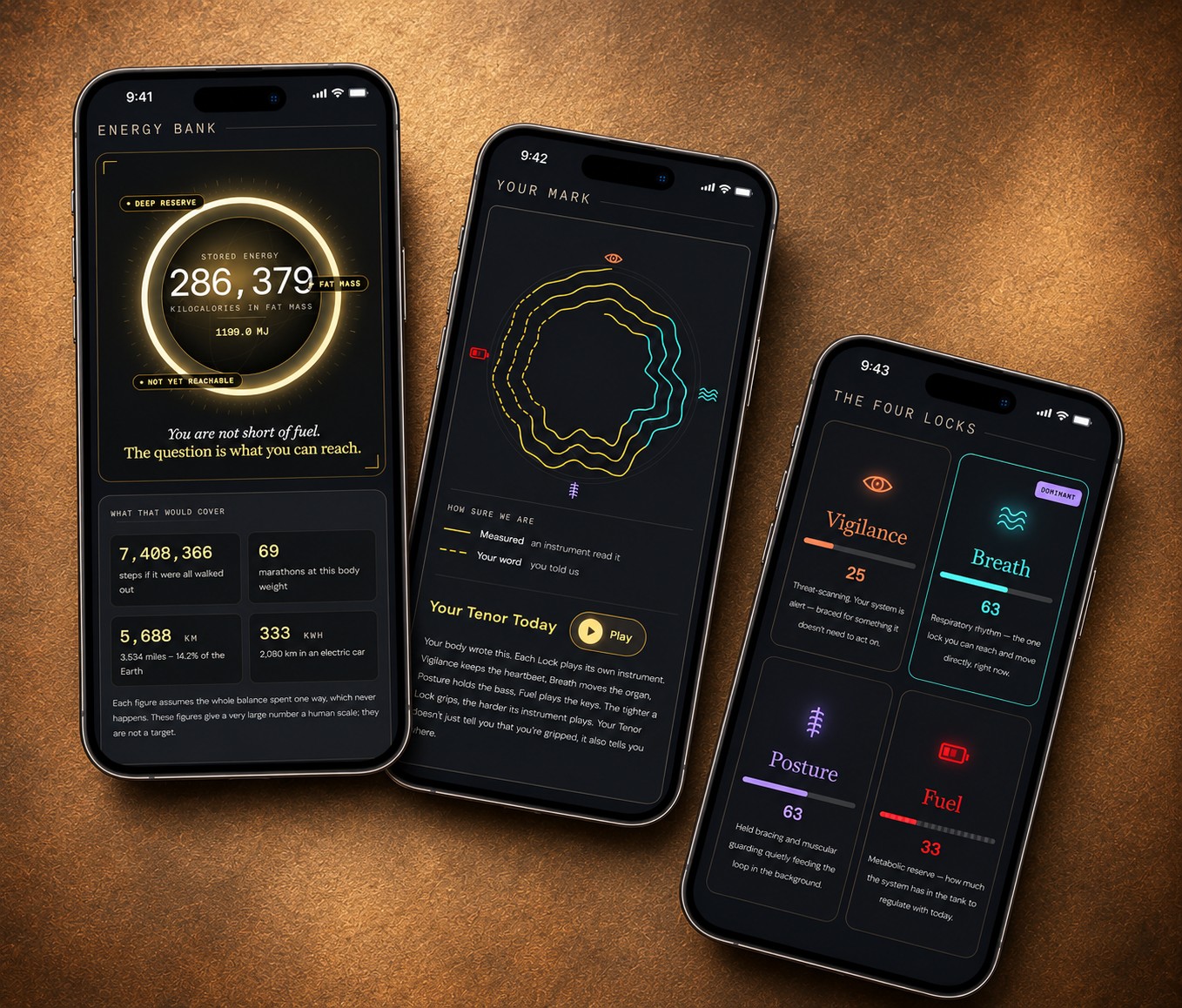
On the front cover you were promised a FREE NeuraGrip™ Scan. That instrument is called the NeuraGrip Polygraph in its original technical sense, a ‘many-writings’ record of multiple physiological channels read together. In that sense it reflects the body’s truth. It reads trend marker patterns of the body’s autonomic state.
A book can explain a mechanism. It cannot measure yours.
Your nervous system is adjusting every second, to caffeine, screens, deadlines, missed sleep, emotional load. Static instruction does not recalibrate dynamic physiology. Feedback does.
The shift you felt is subjective. The pattern behind it is measurable. What follows in this book will read differently once you know your coordinates within it.
To see the pattern is the first step. To measure it is the second. Before you read another page, identify your own coordinates within the siege.
NOW LOOK FOR YOURS.
The live NeuraGrip Polygraph opens in a new tab so this reading position stays open.
The NeuraGrip Polygraph places your configuration within the pattern. Where this book describes the architecture, the NeuraGrip Polygraph identifies your coordinates inside it, which Locks are dominant, how much autonomic reserve your system is currently carrying, and how your baseline compares to the population from which the framework was built.
You have the coordinates. The book has the map.
You can track your trajectory. Each scan is logged. Over weeks of practice, you can track whether the Locks soften, the NGI falls, and the charges slow.
You cannot change what you cannot see. You have just seen it.
The Vigilance Lock
The Command Layer.
“They’re not grinding,” the dentist said. “They’re holding. Like they don’t want to let anything slip.”
The Recognition
Stop for a moment and turn your attention to the background. Right now, nothing is happening. No one needs you. There is no threat in the room.
Notice your jaw: are the back teeth lightly touching, set, when there is nothing to bite down on? Now notice whether some part of you is still leaning forward, listening for the next message, the next interruption, the next thing about to require you, the urge to reach for your phone though it has not made a sound.
The readiness is running. There is simply nothing for it to answer.
You are braced for something that is not there. It will not feel like fear. It will feel like being awake, like focus, like simply how you are.
That readiness, running when nothing requires it, is the Vigilance Lock, running underneath this very paragraph.
It shows up in the jaw that never quite unclenches. In teeth that touch even when the mouth is closed. In temples that ache without explanation. In eyes that narrow slightly as if the world can’t quite be trusted.
It probably came on quietly, years ago. You did not feel it install. You feel only what it produces: the morning headache that has become familiar, the jaw click you pretend not to hear, the way you grind through difficult emails as if your molars were doing the typing.
This lock forms at the top. The cranial system, jaw, neck, eyes all stabilise sensory input when the environment feels unpredictable. A still jaw and fixed gaze reduce sensory variability and feed the brainstem a continuous signal of readiness.
The lock isn’t in the tissue. It’s in the order being given and why it holds.
The Visual Narrowing
Of all the components of Vigilance, the visual system is the one most people have never been told to notice, and the one with the most immediate access to the brainstem’s threat calculation.
When a nervous system is organised around threat detection, vision changes. The eyes narrow their field; peripheral awareness fades; attention tunnels forward onto the most proximate object of concern and stays locked.
In a meadow on the savannah, this is the right strategy. In a modern office, the thing the eyes are locked onto is a screen twelve inches from your face. The peripheral world, which contains the safety signals the brainstem needs to stand down, has vanished from the evidence stream entirely.
The eyes narrow before the mind notices stress. The brainstem notices first.
This creates a loop that is invisible precisely because it is visual. The more vigilant the brainstem becomes, the more the eyes narrow. The more the eyes narrow, the less peripheral safety information the brainstem receives. The less safety information it receives, the more vigilant it remains.
The loop is self-sealing and self-concealing. You cannot see the tunnel you are in because the tunnel has become the entirety of your vision.
For most people, it releases slightly, without being asked to, without any conscious instruction directed at the jaw. Because the jaw and the eyes are components of the same lock. The visual system sent a safety signal and attention widened. The brainstem updated its verdict. The jaw received new orders.
That is not a relaxation technique. That is the architecture of the system working in reverse, as it was designed to, with different evidence.
The Three-Billion-Dollar Receipt
If the Vigilance Lock had a single most visible expression in modern dentistry, it would be the night guard.
Every night, somewhere between one in ten and one in twelve adults grinds or clenches their teeth in their sleep. They wake with jaw tension they cannot quite locate. They develop the morning headache that has become so common it is treated as a personality trait rather than a symptom. Their partners describe a sound that has become familiar in the dark. They are sent to the dentist. The dentist makes them a mouth guard.
The mouth guard is correct, as far as it goes. It protects the teeth from the grinding. What it does not do, what it cannot do, is interrupt the command that is producing the grinding in the first place.
Every product in that market addresses the expression. None of them addresses the order being given.
A person can wear a custom night guard for fifteen years and still wake with a clenched jaw. The guard was never going to release the grip. It was always going to be a receipt for it.
What Maintains It
Continuous jaw contact and fixed gaze. As long as the teeth are touching and the eyes are scanning, the trigeminal and visual pathways are sending the same message upward. The order to hold does not change until the signals that issued it do.
The Vigilance Lock issues the command. The other three Locks carry it out.
YOU HAVE FOUND ONE LOCK.
THERE ARE THREE MORE.
You have recognised the signals. You have tested whether your body can shift. You have measured a moment of your own physiology. And you have opened one of the Four Locks.
But Vigilance is only the command layer.
What happens next explains how the command moves into breath, posture, metabolism, sleep and the biological costs that can accumulate when the system does not stand down. Then the book changes direction: from what is holding you to what lets go.